
By Alexandre Marlet - Chief Marketing Officer & former Industrial Analyst | October 2026
What Musk has said
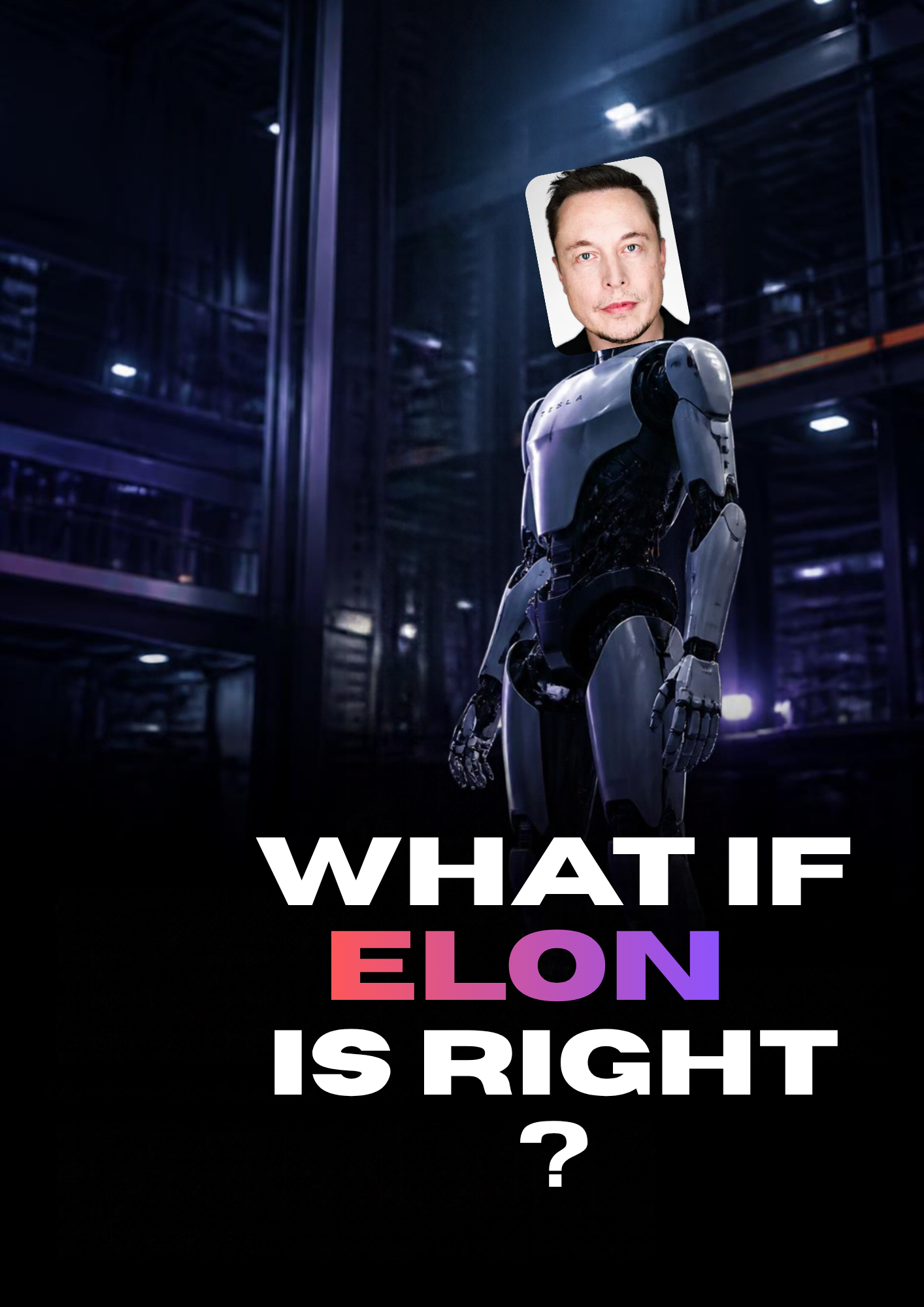
Over the past months, Elon Musk has repeated a series of bold predictions about artificial intelligence and robotics. As reported by the press, he said at the World Economic Forum in Davos in January 2026 that AI could be smarter than any single human by the end of the year, and that robots will eventually outnumber people. On a podcast with Peter Diamandis the same month, he suggested that within roughly three years there could be more Optimus robots acting as great surgeons than human surgeons on Earth. In June, he added on X that AI could exceed the sum of all human intelligence within four to five years.
These are predictions, not established timelines, and Musk's deadlines have a record of slipping. Love him or hate him, though, the exact dates matter less than the direction: machines that do more cognitive and physical work, at falling cost. The interesting question for an investor is not whether Musk is right on the calendar. It is what happens to the way wealth is created if he is even partly right.
From earning to owning
The model we were all raised in
For most of the last two centuries, the dominant path to wealth in developed economies has been simple: acquire skills, sell your time to an employer, earn a salary, save part of it and eventually invest in stocks or bonds. Human capital, meaning what you know and what you can do, was the main asset most people owned. Education, careers and even the way we think about success are built around this idea. It worked because labor was scarce, hard to replace and necessary for almost every form of production.
What changes when labor becomes replaceable
If AI can perform an increasing share of cognitive tasks, and robots an increasing share of physical ones, the scarcity that underpinned wages starts to erode. A software agent can be copied at almost zero marginal cost. A robot, once built, can work every hour of the day. That does not mean work disappears overnight. History reminds us that previous technological revolutions destroyed some jobs and created others, and nobody can say with confidence that this time will be different. But it does mean that the bargaining power of labor, and therefore its share of the value created, is under pressure in a way it has not been before.
When something becomes abundant, its price falls. When something else stays scarce, its value rises. AI can multiply intelligence and robots can multiply physical effort, but neither can create more land, more prime real estate, more electricity or more raw materials. They need all of them, and in larger quantities. Value therefore migrates from the abundant factor, labor and generic intelligence, towards the scarce ones: land, energy, physical infrastructure, critical materials and, increasingly, data and compute.
Wages versus rents
This is the heart of the argument. In a labor economy, income is mostly a wage: a payment for a task performed, advice given or hours worked. In an ownership economy, a growing share of income takes the form of a return on assets owned: rent, dividends, royalties, capital gains. The economist Thomas Piketty built much of his work on the observation that, over long periods, returns on capital tend to exceed the growth rate of the economy and of wages. Automation, if it advances as Musk expects, would push in the same direction by shifting more of the output from payroll to the owners of machines and infrastructure.
The practical consequence is a change in the question we ask. The old model was: work hard, earn a salary, build wealth. The emerging one looks more like: own productive assets, generate returns, build wealth. The factory, the data center, the power plant, the building and the plot of land become the engines of income. Selling your time, however skilled, remains valuable, but it becomes harder to compound.
A Swiss angle
This shift has a particular resonance in Switzerland. The country has one of the lowest homeownership rates in Europe, so a large part of the population earns a wage and pays rent, which is exactly the position that would be squeezed in an ownership economy. At the same time, Switzerland's occupational pension system, the second pillar, means that many employees already own a slice of the economy indirectly, through pension funds invested in equities, real estate and infrastructure. How these funds position themselves for automation will matter more for ordinary savers than most of them realize.
What could prove this wrong
It would be dishonest to present this as a certainty. There are at least three serious counterarguments. First, adoption may be much slower than predicted, or new kinds of jobs may absorb displaced workers, as they have in the past. Second, ownership of machines is not automatically a source of rents: if robots become cheap and widely available, competition could compress the returns of anyone who simply owns them. The winners are more likely to hold assets that are genuinely scarce, such as prime land, grid access, critical materials or unique data and technology. Third, societies may respond with new taxes on capital, new redistribution schemes or regulation, which would change who keeps the gains.
We do not know whether people will stop working. But the value of labor is likely to decline relative to the value of ownership.
That is what we believe at the Investment Society Lausanne. It is a view about direction, not a forecast of dates, and it should be held with humility.
Who sits on the other side of the trade
If ownership of productive assets becomes the central source of value, the next question is where those assets are. Following the value chain of an AI and robotics economy, we see six areas worth watching. The table below gives examples of players, not recommendations.
| Sector | Why it matters | Examples of players |
|---|---|---|
| Energy | AI and robots are power hungry; the grid becomes a bottleneck. | Constellation Energy, NextEra Energy, Schneider Electric |
| Metals & materials | Robots, chips and data centers need copper, lithium and rare earths. | Glencore, Rio Tinto, Albemarle |
| Semiconductors | The compute layer behind both AI models and robot brains. | Nvidia, TSMC, ASML |
| Industrial robotics | Established players already deploying machines at scale. | Fanuc, ABB, Keyence, Yaskawa |
| Humanoid robotics | Early stage; mostly private or part of larger groups. | Tesla (Optimus), Figure AI, Boston Dynamics, Agility Robotics |
| Healthcare | Surgical robotics, diagnostics and drug discovery. | Intuitive Surgical, Medtronic, Recursion Pharmaceuticals |
Energy: the first bottleneck
Training and running AI models, and powering fleets of robots, requires large amounts of electricity. Operators of nuclear and renewable generation, such as Constellation Energy and NextEra Energy, and the companies that supply the electrical equipment for grids and data centers, such as Schneider Electric, sit at the base of the chain. Reliable power is increasingly the scarce input.
Metals and materials: the physical foundation
Robots, chips, batteries and data centers are made of copper, lithium, rare earths and other materials that must be mined and refined. Diversified miners like Glencore and Rio Tinto, and lithium producers like Albemarle, are exposed to this demand, with the usual caveat that commodity prices are volatile and supply can respond slowly.
Semiconductors: the brain
Nvidia designs the chips most associated with AI training, TSMC manufactures a large share of the world's most advanced semiconductors, and ASML supplies the lithography machines that make that manufacturing possible. This is the most crowded part of the theme, and valuations already reflect high expectations.
Industrial and humanoid robotics: the body
Established industrial players such as Fanuc, ABB, Keyence and Yaskawa already sell robots and automation systems at scale. Humanoid robots are earlier: Tesla's Optimus is the best known project, while Figure AI, Boston Dynamics and Agility Robotics are mostly private or part of larger groups, which limits direct access for most investors.
Healthcare: where the promise is most tangible
Surgical robotics, diagnostics and drug discovery are already areas where automation and AI deliver measurable results. Intuitive Surgical, Medtronic and Recursion Pharmaceuticals illustrate different ways to be exposed, from established systems to research-driven models.
Real assets: land, property and infrastructure
Beyond listed companies, the same logic applies to the physical layer itself: data center real estate, industrial land, logistics, energy infrastructure. These are the assets that robots and AI need but cannot replicate, and they are the most direct expression of the shift from labor to ownership.
What do you own?
Whether Musk's timeline is right or five years too optimistic, the structural question is the same. For a generation of students about to enter the job market, the traditional advice of building skills and a career remains valid, but it may no longer be sufficient on its own. Starting to think early about ownership, whether through equity markets, real assets or pension allocations, is a sensible complement.
The question is no longer only “what do you do?”. It is also “what do you own?”
Sources and notes
Musk's statements are quoted as reported by the press: WEF Davos, January 2026; Peter Diamandis podcast, January 2026; post on X, June 2026.
Thomas Piketty, Capital in the Twenty-First Century (2013), for the r > g argument.
This article reflects the personal views of its author and is provided for information and education purposes only. It is not investment advice, and the companies mentioned are examples, not recommendations.
Alexandre Marlet
Investment Society Lausanne